


Monemvasia – A Feast for the Eyes and Soul, Inside & Out | Greece

Monemvasia is one of the most visually striking destinations in Greece. Built on a massive rock in the sea, it offers constant, unobstructed views of the horizon, with every corner of the town feeling carefully preserved and uniquely beautiful.

Beyond the scenery, what stands out is the overall atmosphere as well as the genuinely kind and welcoming attitude of the locals.
To experience it at its best, it’s worth visiting during spring or autumn, offering more comfortable conditions to truly enjoy the place. Me and my friends visited Monemvasia in the spring— and that’s exactly what we’ll walk you through next.
A Brief History of Monemvasia
Monemvasia was founded in the 6th century AD, during the Byzantine era, when local populations moved to the rock for protection from invasions. Its name comes from the Greek words “moni” (single) and “emvasis” (entrance), referring to the fact that the town is accessible through just one main gate.
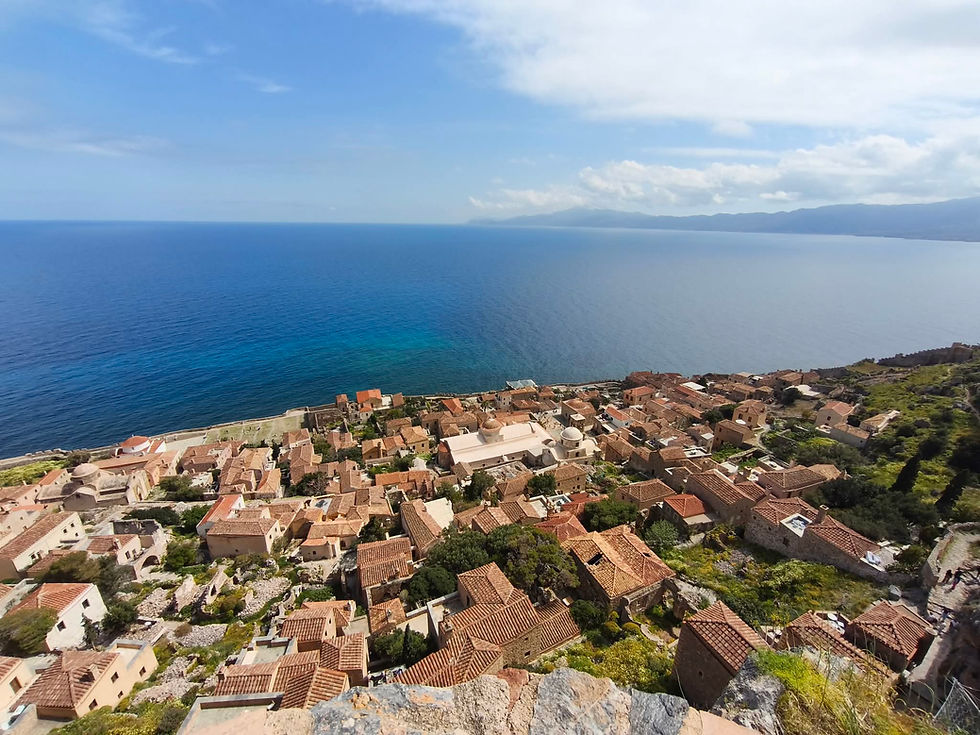
During Byzantine times, Monemvasia developed into an important trading hub, thanks to its strategic position along key maritime routes. It became known for products such as wine, olive oil, and silk, while the name “Malvasia” wine is historically linked to the town, as Venetian traders used it as a key export point for sweet wines across Europe.
The settlement was divided into the Upper Town and the Lower Town. The Upper Town included administrative and religious buildings, while the Lower Town functioned as the main residential and commercial area. Over time—especially during Venetian rule—the Lower Town remained active, while the Upper Town was gradually abandoned.
Today, Monemvasia is a protected historic settlement, but it is far from a “museum.” The Lower Town is still inhabited, with homes, boutique hotels, and Airbnbs operating within the old stone buildings—offering a unique experience of staying inside a living medieval town. At the same time, most of the permanent population now lives in the modern town on the mainland, just across the bridge.
What to See in Monemvasia
Exploring the Town
When you enter Monemvasia through the main gate, you’ll immediately find yourself on the central street—the main path where most cafés, restaurants, and small shops are located. It’s a useful reference point to help you navigate the town.

From there, you can turn into any alley and just explore. And honestly, this is where the magic is. You’ll keep discovering hidden corners, views, and details that you don’t expect.
At some point, you’ll realise you’re not even putting your phone away—you’ll have it in your hand the whole time, constantly taking photos and videos. That’s exactly what happens here. There are so many small, beautiful moments in every corner that you simply don’t get enough of them.
The House of the Greek Poet Yannis Ritsos
One of the first stops worth making in Monemvasia—literally just after you enter the main gate—is the house of Yannis Ritsos, one of Greece’s most important poets.

Today, it operates as a biographical museum and is honestly one of the most impressive of its kind you can visit. The way his life and work are presented is modern, interactive, and very engaging, making it interesting even if you’re not already familiar with his poetry.

The museum is relatively new and housed in his actual home, which adds to the overall experience. Entrance is around €6, and it’s absolutely worth it—not only to learn more about an important Greek figure, but also to experience a beautifully curated space. The museological study was carried out by Tetragon, and the result really stands out.
A Quick Note on Other Museums: There are also a couple of smaller museums in Monemvasia: a small archaeological museum (with Byzantine exhibits) and a folk museum. They’re worth a quick visit if you have extra time!The Two Squares & their Churches
As you walk through Monemvasia, the central street you enter from the main gate naturally leads you all the way to the Main Square (Kentriki Plateia). This is essentially the “end point” of the main path where you’ll find the Church of Christ in Chains (Elkomenos Christos), one of the most important churches in Monemvasia.
From there, if you continue walking down towards the sea, you’ll reach the Lower Square (Kato Plateia). This part feels completely different—more open, right by the water, and with a direct view of the sea.

It’s actually one of the most interesting spots, because you can turn around and see the town rising above you from a totally different perspective.
It’s also the point where the city “opens up,” breaking away from the narrow alleys and creating a more relaxed atmosphere.
This is where you’ll find the Church of Panagia Chrysafitissa, a beautiful church that becomes the focal point during Easter, hosting the Resurrection and Epitaph ceremonies and bringing together both locals and visitors in a very special setting.
Hagia Sophia Church & the Upper Town
The Upper Town (Ano Poli) of Monemvasia is one of the most impressive parts of the area, offering a completely different perspective compared to the Lower Town. Today, it feels completely abandoned, with ruins, open spaces, and a raw landscape that makes the whole climb worth it.
Historically, the Upper Town was the administrative and defensive center of Monemvasia, especially during the Byzantine period (from the 6th century onwards). It housed important buildings, including churches and fortifications, and played a key role in protecting the settlement. However, over time—particularly after the Venetian and later Ottoman periods—the Upper Town was gradually abandoned, with residents moving down to the Lower Town, which was more accessible and practical for daily life.

At the top, you’ll find the Church of Hagia Sophia, built in the 12th century. It’s a striking example of Byzantine architecture, with a style inspired by Hagia Sophia in Constantinople—this is also where it takes its name from. Over the centuries, it changed use multiple times—serving as an Orthodox church, a Catholic monastery (Madonna del Carmine), and later a mosque during Ottoman rule—before returning to its current form. It was restored in the 20th century by Efstathios Stikas.
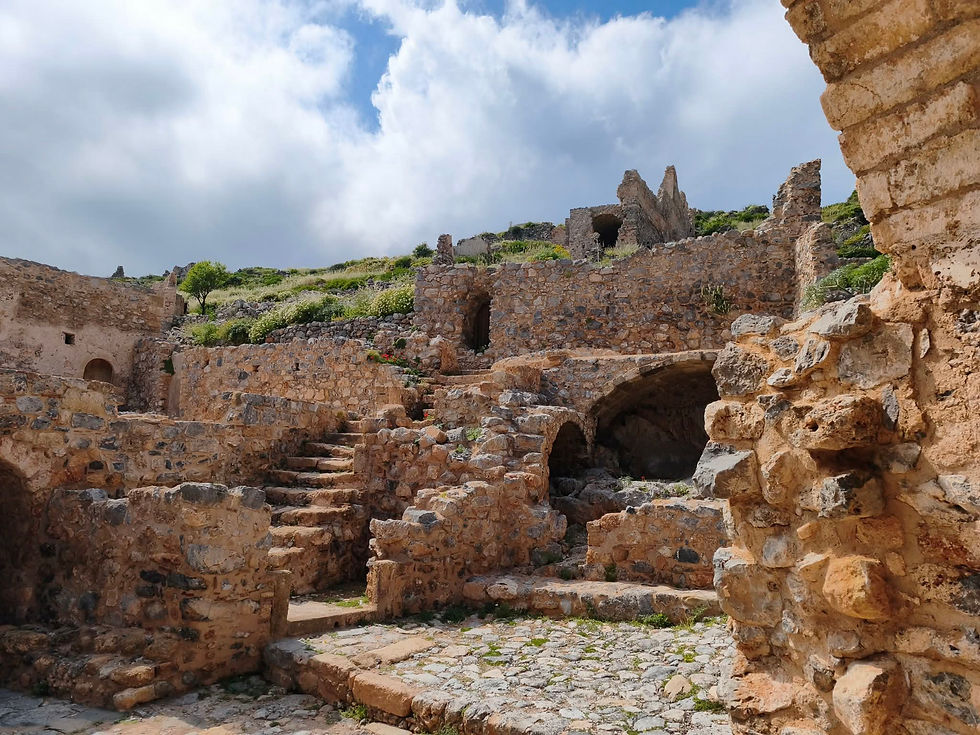
Getting there: The hike takes around 30 minutes and is quite demanding. The path is steep, with uneven and often slippery stones, so proper footwear is essential—ideally sport or trail running shoes. There is no shade along the way, so make sure to bring water and sun protection.
It’s not recommended for elderly visitors or people with mobility issues, and extra care is needed on the way down.
Worth it? Absolutely. The view from the top is breathtaking, and the church itself is truly impressive. On the way up, you’ll pass through arches and viewpoints, with endless opportunities for photos.
Tip: The church usually closes early in the afternoon, so make sure to plan your visit accordingly—it would be a shame to make the climb and find it closed.
Food, Coffee & Shopping in Monemvasia
Monemvasia offers plenty of options for food, coffee, and shopping—and overall, the level of service is genuinely impressive. We didn’t experience a single moment of bad service; people are warm, professional, and it honestly feels like the place hasn’t been “spoiled” by tourism.
Coffee is something we highly recommend here. The views are beautiful, the quality is high, and there are plenty of great spots along the main street—especially near the entrance. For brunch or coffee, places like Emvasis Café and Enetiko Café are great choices, while Vathysfairo Bar is a great option for drinks and a more lively atmosphere, popular with both visitors and locals. If you’re looking for coffee to go, Volas is a very good and convenient choice.
For food, Matoula is a solid option inside the castle—great location, beautiful setting, and very good service. It’s on the pricier side, as expected, and the food is good.
If you’re open to going a bit outside, Tavern Athas Tavern in the nearby village of Agios Ioannis is honestly a hidden gem. The village itself is nothing particularly special, but this place alone is reason enough to go. The food is outstanding, the portions generous, the prices very reasonable—and overall, it’s one of those unexpected finds that ends up being a highlight of the trip. Alternatively, locals recommended Psarochori in Limenas Geraka for fresh fish — it’s also just a 10-minute drive.

For shopping, the main street has several lovely spots with local products like jams, pasta, and traditional goods (I recommend the Kelari), as well as small boutiques with Greek designer clothing. It’s worth stopping by, both for the products and for the tips you’ll get from the locals working there.
Final Thoughts
Staying inside Monemvasia is a beautiful experience on its own. Yes, it’s more expensive, but waking up inside the castle, surrounded by stone buildings and sea views, is something unique. Options like Likinia Hotel, right by the Lower Square, are especially worth it for the atmosphere and location.
That said, there are also great alternatives. You can stay just outside the castle or in the new town of Monemvasia, which is within walking distance. Even options a bit further out (around a 10-minute drive like I did) can be a great choice—more affordable, with equally beautiful views, and you don’t really miss out on the experience.
![Monemvasia | Pic.: Evangelos Mpikakis [unsplush]](https://static.wixstatic.com/media/nsplsh_325418cdb8944d99b07c2bebc63c5883~mv2.jpg/v1/fill/w_980,h_1022,al_c,q_85,usm_0.66_1.00_0.01,enc_avif,quality_auto/nsplsh_325418cdb8944d99b07c2bebc63c5883~mv2.jpg)
Keep in mind that access to the castle involves walking—about 1 km from the parking area to the main gate. Parking is free, and there are also small buses and even scooters available if you don’t feel like walking.
As for timing, spring and autumn are by far the best periods to visit. In winter, the stone paths can become slippery and difficult to walk on, while in summer the heat can be intense, especially since the entire town is built on rock with very little shade. It’s fine for a short visit to have one coffee, but not ideal if you want to fully explore.
Ideally, plan to stay around three days—that’s the perfect amount of time to experience Monemvasia at a relaxed pace without rushing.
Sonia Gerodimou

